
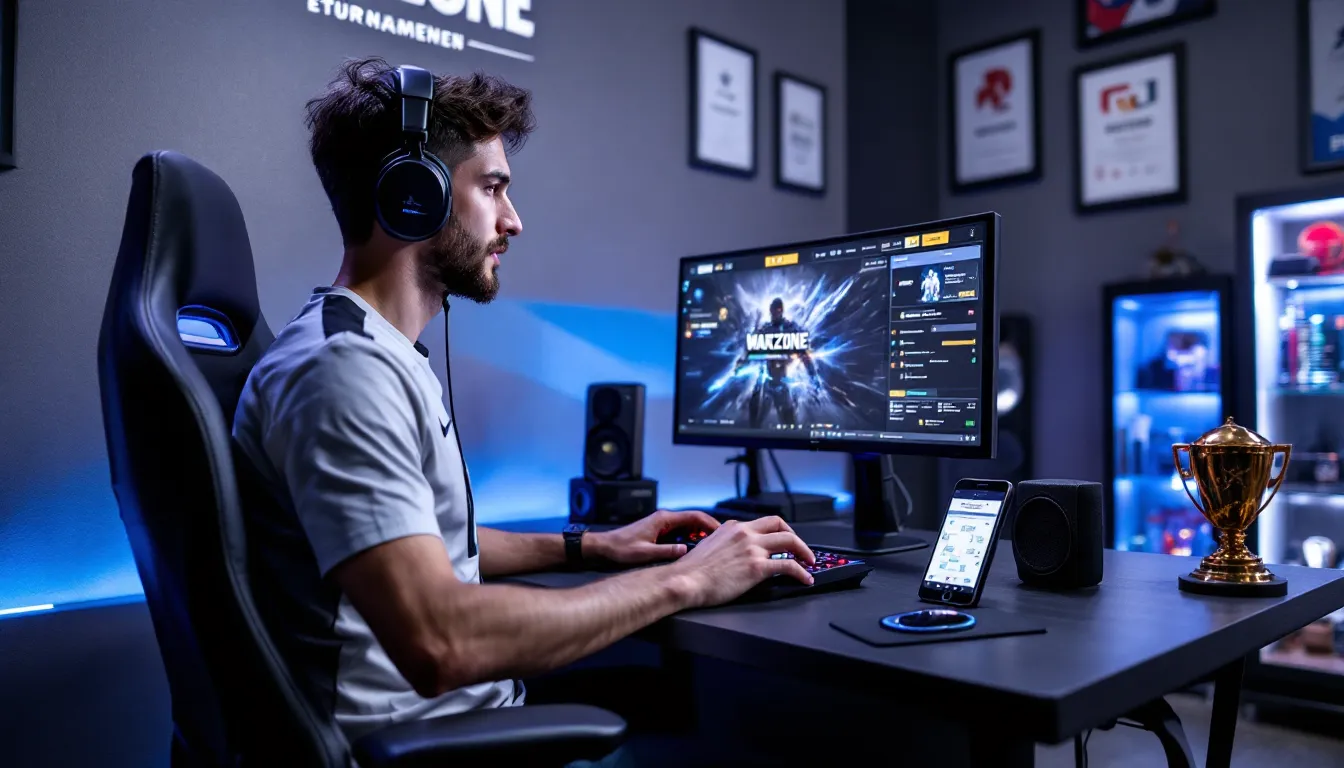
Competitive Warzone isn’t just for content creators and professional players anymore. Whether you’re grinding Urzikstan solos or stacking wins in Resurgence quads, tournament play offers a legitimate path to test your skills, earn real money, and potentially launch an esports career. In 2026, the Warzone competitive scene has matured beyond its chaotic early days into a structured ecosystem with multiple tournament circuits, prize tiers, and entry points for players at every skill level.
This guide breaks down everything you need to know about entering, preparing for, and succeeding in Warzone tournaments. From finding your first community bracket to understanding CDL-adjacent events, from building a cohesive squad to avoiding the technical pitfalls that eliminate teams before they even drop in, consider this your tactical briefing for competitive play.
Key Takeaways
- Warzone tournaments now offer structured competitive play with multiple entry points, from free grassroots community brackets to six-figure prize pools in official Activision events, making competitive gaming accessible to players at every skill level.
- Success in Warzone tournaments requires specialized preparation beyond pub-match skills, including map mastery, team coordination, meta loadout optimization, and mental resilience—not just mechanical aim.
- Top tournament platforms like CheckMate Gaming, GameBattles, and Battlefy provide the primary infrastructure for competitive play, with most requiring account verification, two-factor authentication, and gameplay recording for dispute resolution.
- Prize pools range dramatically based on tournament tier, from $10–$50 wager matches to $100,000–$300,000 in officially sanctioned events, with approximately 400–600 players earning over $10,000 globally in 2025.
- Common tournament elimination mistakes—over-aggression early game, poor gas management, tilting after losses, and registration oversights—often cost matches and earnings more than mechanical skill gaps.
- Building a competitive Warzone team focuses on communication chemistry and playstyle alignment rather than individual talent alone, with defined roles (IGL, Fragger, Support, Long-range specialist) creating coordinated squad performance.
What Are Warzone Tournaments and Why They Matter
Warzone tournaments are organized competitive events where players or teams compete for prizes, rankings, and recognition. Unlike public matchmaking where you’re fighting for a dopamine hit and camo unlocks, tournament play involves structured rulesets, eligibility requirements, and real stakes, whether that’s a $50 payout for a local Discord bracket or a six-figure prize pool in an officially sanctioned event.
The competitive scene serves multiple purposes beyond bragging rights. It’s a proving ground for aspiring pros, a revenue stream for skilled grinders, and a content goldmine for streamers looking to differentiate themselves from the endless parade of pub-stomping montages.
The Evolution of Competitive Warzone
Warzone’s competitive journey has been turbulent. The original Verdansk era (2020-2021) saw explosive growth in third-party tournaments but struggled with cheating scandals and inconsistent anti-cheat enforcement. When Caldera launched in December 2021, competitive interest waned as the map and meta fell flat with both casual and competitive communities.
The pivot to Warzone 2.0 in November 2022 brought Al Mazrah and a complete engine overhaul on the IW 9.0 platform. Activision attempted to build ranked play directly into the client, though the execution was mixed. By mid-2024, the competitive scene had stabilized around a hybrid model: official Activision events with massive production value, and a thriving third-party ecosystem powered by platforms like CMG, GameBattles, and Battlefy.
As of March 2026, Warzone Urzikstan (which launched with MW3 integration in late 2023) remains the primary competitive map for Battle Royale formats, while Resurgence modes on Rebirth Island and Fortune’s Keep maintain dedicated tournament circuits. The anti-cheat situation has improved dramatically with Ricochet 3.5, making competitive integrity the best it’s ever been.
Prize Pools and Career Opportunities
The money in Warzone tournaments spans an enormous range. Small-scale wager matches start at $10-$50 buy-ins with winner-take-all or top-three splits. Mid-tier platform tournaments typically offer $500-$5,000 prize pools with placement-based distribution.
At the top end, Activision-backed events can reach $100,000-$300,000 in total prizes. While these don’t match the multimillion-dollar pools of games like Dota 2 or Fortnite, they’re sufficient to support a competitive ecosystem. According to tournament tracking data, approximately 400-600 players globally earned over $10,000 from Warzone competitions in 2025.
Beyond direct winnings, tournament success opens doors to content creation sponsorships, team signings, and coaching opportunities. Several current Call of Duty League players started in Warzone tournaments before transitioning to traditional competitive CoD formats.
Types of Warzone Tournaments You Can Enter
The tournament landscape offers multiple pathways depending on your skill level, time commitment, and competitive goals. Understanding the differences helps you choose events that match your current abilities while building toward higher-tier competition.
Official CDL and Activision-Sponsored Events
Activision runs periodic showcase tournaments tied to seasonal content drops and CDL events. These typically feature invited professional players and content creators but occasionally include open qualifiers.
The Warzone Championship Series, introduced in 2024 and continuing through 2026, represents Activision’s primary competitive circuit. It features regional qualifiers (NA, EU, APAC, LATAM) leading to LAN finals. Prize pools range from $150,000-$300,000 depending on the season.
Eligibility for these events is strict: verified accounts, two-factor authentication, streaming/recording requirements for top placements, and often age restrictions (18+ for most). The competition level is brutal, these events attract the absolute best players globally.
Third-Party Platform Tournaments
This is where most competitive players cut their teeth. Platforms like CheckMate Gaming (CMG), GameBattles, Battlefy, and Players’ Lounge run daily and weekly tournaments with varying buy-ins and formats.
These tournaments range from free-entry brackets with small prizes to premium events with $25-$100 entry fees and proportionally larger payouts. The skill distribution varies wildly, you might face a casual squad in round one and a semi-pro team in round two.
Most third-party platforms use automated matchmaking and reporting systems, though disputes still happen. Screenshot evidence of scoreboard results is standard, and many platforms now require match recording for top placements.
Community and Grassroots Competitions
Discord servers, content creator communities, and regional gaming organizations host regular tournaments. These events often prioritize community building over prize money, though many still offer $100-$1,000 pools funded by entry fees or sponsorships.
Grassroots tournaments are excellent for beginners. The competition is generally less intimidating than platform events, and the community atmosphere makes it easier to network, find teammates, and learn from more experienced players. Finding opportunities through free gaming tournaments can help new competitors gain experience without financial risk.
Wager Matches and Cash Tournaments
Wager matches (often called “GBs” regardless of platform) involve direct buy-ins where teams put up money and winner takes all or splits according to agreed terms. These aren’t tournaments in the traditional bracket sense but represent a significant portion of the competitive ecosystem.
Typical wager amounts range from $10-$500 per team, with serious competitors regularly running multiple matches per session. The stakes create intense gameplay, but also increase the likelihood of disputes and accusations. Only use established platforms with dispute resolution systems, never transfer money directly to opponents you don’t know.
Where to Find and Register for Warzone Tournaments
Discovering tournaments requires active monitoring across multiple channels. Unlike games with centralized competitive hubs, Warzone’s tournament scene is distributed across various platforms and communities.
Top Tournament Platforms and Websites
The major third-party platforms each have distinct characteristics:
CheckMate Gaming (CMG) remains the most popular platform for North American players. It offers daily tournaments, ladder matches, and wager systems with automated dispute resolution. Registration requires account verification and two-factor authentication. CMG’s interface is clean, and payout processing typically takes 3-5 business days.
GameBattles (owned by MLG/Activision) is the OG platform with the longest history in Call of Duty competition. It has a more complex ruleset system and stronger integration with official competitive structures. The user interface feels dated compared to newer platforms, but the competition quality is consistently high.
Battlefy focuses on larger bracket tournaments rather than continuous ladders. It’s popular with tournament organizers because of its robust admin tools. Many community and sponsored events use Battlefy for registration and bracket management.
Players’ Lounge emphasizes wager matches and head-to-head competition. It has a streamlined dispute system and faster matchmaking than bracket-based platforms, but less variety in tournament formats.
Most platforms require linking your Activision account, verifying email and phone number, and maintaining account standing (no recent bans or suspicious activity). Browse upcoming events, check eligibility requirements, and register before brackets fill, popular tournaments often reach capacity hours before start time.
Discord Communities and Social Media Channels
Discord has become the primary organizational hub for grassroots competition. Servers like Warzone Competitive Hub, Verdansk Veterans, and various content creator communities host weekly and monthly events.
To find these communities:
- Follow competitive Warzone players and organizations on Twitter/X, they regularly announce tournaments and drop Discord invites
- Search Reddit’s r/CODWarzone for tournament announcements (use the competitive flair filter)
- Join platform-specific Discords (CMG, GameBattles, etc.) which often announce exclusive events
- Follow tournament organizers and sponsors who run recurring events
Twitter/X and TikTok are increasingly important for tournament discovery, especially for creator-hosted events and sponsored competitions. Enable notifications for key accounts to catch limited-entry tournaments before they fill.
Essential Requirements and Eligibility
Tournament organizers impose requirements to ensure competitive integrity and legal compliance. Missing any of these can result in disqualification, even after winning matches.
Age Restrictions and Regional Limitations
Most paid tournaments require participants to be 18 or older due to gambling laws and payout processing regulations. Some free-entry community events allow younger players with parental consent, but this varies by jurisdiction.
Regional restrictions exist for several reasons. Some tournaments are limited to specific continents or countries to manage server latency and ensure fair competition. Others face legal restrictions, certain jurisdictions prohibit skill-based gaming for money, making residents ineligible regardless of age.
Always verify your region is included before registering. VPN use is universally prohibited and typically results in permanent platform bans.
Hardware and Internet Connection Standards
Tournaments don’t mandate specific hardware, but you need equipment capable of recording gameplay and maintaining stable performance. Minimum effective specs for competitive Warzone in 2026:
- PC: RTX 3060/RX 6700 XT or better, 16GB RAM, modern CPU (Intel 12th gen / Ryzen 5000+)
- Console: PlayStation 5 or Xbox Series X (last-gen consoles are technically eligible but competitively disadvantaged)
- Internet: 50+ Mbps download, 10+ Mbps upload, sub-40ms ping to game servers, wired connection strongly recommended
Many tournaments require gameplay recording for dispute resolution and anti-cheat verification. PC players should use OBS, ShadowPlay, or Medal. Console players can use built-in recording features, though some tournaments require external capture cards for higher placements.
Account Standing and Anti-Cheat Compliance
Your Activision account must be in good standing, no active bans, no suspicious statistics, and no history of cheating accusations. Tournament platforms often run preliminary checks on registered accounts, and anything flagged by Ricochet or manual review makes you ineligible.
Two-factor authentication is mandatory for almost all competitive play. Enable it on both your Activision account and the tournament platform you’re using.
Some tournaments require specific in-game settings or configurations. Common examples include forcing certain graphics options to prevent exploits, disabling crosshair overlays, or limiting specific accessibility features that could provide unfair advantages. Read ruleset documentation thoroughly before match time.
Tournament Formats and Rule Sets Explained
Understanding format variations is critical. The same skills that dominate public matches may not translate directly to competitive settings where scoring systems and win conditions differ.
Battle Royale Kill Race Tournaments
This format emphasizes aggression and mechanical skill over traditional survival tactics. Teams compete across a set number of matches (typically 3-6 games), with rankings determined by total kills accumulated.
Point systems vary, but common structures include:
- Kills only: Pure kill count, no placement points
- Weighted kills + placement: Kills worth 1 point, placement bonuses (10 points for 1st, 6 for 2nd, etc.)
- Per-game elimination: Bottom performers eliminated after each round until finals
Kill race formats favor aggressive playstyles, hot drops, and high-risk rotations. Teams frequently contest popular POIs knowing that avoiding combat costs them competitive standing. Coverage from outlets following competitive FPS strategies often highlights how kill race dynamics differ from standard Battle Royale.
Resurgence and Custom Lobby Formats
Resurgence tournaments on Rebirth Island or Fortune’s Keep use the respawn-enabled mode, creating entirely different strategic dynamics. Matches are shorter (12-15 minutes vs 25-30 for BR), and the faster pace rewards constant pressure and spawn control.
Custom lobby formats gather all competing teams into a private match with spectator slots for admins and sometimes live broadcasts. This is the gold standard for competitive integrity, everyone plays simultaneously in identical conditions, eliminating server variation and matchmaking inconsistencies.
Custom lobbies are standard in high-level tournaments but require organizer infrastructure that smaller events can’t provide. They also need sufficient competing teams to fill lobbies (typically 40-60 players for quads).
Point Systems and Scoring Methods
The point structure fundamentally shapes strategy. Common systems:
Placement-Heavy Scoring:
- 1st: 25 points
- 2nd-3rd: 15 points
- 4th-5th: 10 points
- 6th-10th: 5 points
- Kills: 1 point each
This format rewards survival and smart rotations. Teams avoid unnecessary fights, prioritize positioning, and play for late-game placement.
Kill-Heavy Scoring:
- 1st: 10 points
- 2nd-5th: 5 points
- 6th-10th: 2 points
- Kills: 2 points each
Aggressive teams thrive here. Winning without kills can be beaten by a team that places mid-tier but racks up 15+ eliminations.
Understanding the scoring system before you drop is non-negotiable. It determines everything from drop location to loadout selection to mid-game rotation decisions.
Building Your Competitive Warzone Team
Solo tournaments exist but represent a small fraction of competitive Warzone. Most events are duos, trios, or quads, making team composition a fundamental success factor.
Finding Compatible Teammates
Skill compatibility matters, but chemistry and communication matter more. A team of individually talented players with conflicting styles will lose to a coordinated squad with slightly lower mechanical skill.
Where to find teammates:
- Tournament platform Discords have LFG (looking for group) channels where players post stats and availability
- Ranked mode matchmaking can identify players with compatible playstyles, add strong teammates and build relationships over multiple sessions
- Community tournaments are networking opportunities: perform well and players will approach you
- Content creator communities often have competitive sub-groups focused on tournament play
When evaluating potential teammates, consider:
- Availability: Can they commit to practice schedules and tournament times?
- Communication style: Do they make clear callouts, or do they rage and tilt?
- Playstyle alignment: Do they match your aggression level and decision-making pace?
- Role flexibility: Can they adapt to different situations, or are they one-dimensional?
Role Distribution and Team Composition
While Warzone doesn’t have rigid class systems like Overwatch or Valorant, effective teams develop role specialization:
IGL (In-Game Leader): Makes rotation calls, manages circles, decides when to engage or disengage. Not necessarily the best fragger, but has strong game sense and decisive communication.
Fragger/Entry: High mechanical skill, takes point on pushes, applies pressure in fights. This player should have the best aim and movement.
Support/Flex: Versatile player who adapts to team needs, covering flanks, securing buybacks, holding positions during rotations.
Sniper/Long Range (in quads): Provides cover fire during rotations, picks exposed enemies, controls sightlines in final circles.
Role distribution should feel natural based on individual strengths. Forcing someone into an incompatible role creates friction and poor performance.
Communication and Strategy Development
Establish communication protocols before you compete:
- Callout consistency: Agree on POI names, directional references, and threat priority language
- Push/fall-back signals: Clear, decisive calls that everyone recognizes immediately
- Combat comms discipline: During active fights, minimize chatter to essential information (enemy positions, damage dealt, abilities used)
Practice together in public matches before entering tournaments. Use these sessions to develop:
- Drop strategies for different starting flight paths
- Loadout priorities and timing
- Standard rotations based on circle positions
- Contingency plans for getting separated or losing teammates early
Record and review your practice sessions. Identify repeated mistakes, communication breakdowns, and positioning errors. The teams that improve fastest are those who actively analyze their gameplay rather than mindlessly grinding matches.
Training and Preparation Strategies
Tournament preparation separates casual players from competitive threats. Success requires targeted practice across multiple skill dimensions.
Mechanical Skills and Aim Training
Raw gunplay fundamentals determine who wins 50/50 fights. Dedicate time to isolated mechanical practice:
Aim training software: Aimlabs and KovaaK’s offer Warzone-specific scenarios. Focus on tracking (following moving targets), flicking (snapping to targets), and target switching (engaging multiple enemies). 20-30 minutes daily produces measurable improvement.
Loadout familiarity: Master your tournament loadouts in private matches or Plunder. Learn exact recoil patterns, damage ranges, and optimal engagement distances. You should be able to control your primary weapon perfectly without conscious thought.
Movement mechanics: Practice slide-cancels (if still available in current patch, mechanics change seasonally), bunny-hops, camera breaks, and advanced movement techniques. Even subtle movement superiority creates advantages in close-range duels.
Current meta loadouts as of March 2026 typically feature:
- Primary: SVA 545 (AR), RAM-9 (SMG for aggressive play), or DG-58 (LSW for range)
- Secondary: Tactical stance SMG (HRM-9, Striker) or sniper support (KATT-AMR, Longbow)
- Perks: Vary by format, but Quick Fix remains essential for tournament sustainability
Meta shifts occur with major patches and seasonal updates, so stay current through competitive gaming guides that track weapon balance changes.
Map Knowledge and Rotations
Urzikstan knowledge separates tournament performers from public match players. Study:
- High-ground positions: Locations that provide circle control and rotation visibility
- Cover density: Areas where you can move safely vs. open terrain requiring vehicle rotations
- Choke points: Narrow passages and bridges where teams converge predictably
- Vehicle spawn locations: Critical for escaping gas or making emergency rotations
- Buy station positions: Knowing every buy location enables strategic loadout timing and emergency plates
Create mental (or actual) rotation maps based on first circle positions. Develop default paths that keep you ahead of gas while avoiding predictable choke points where teams stack up.
Meta Loadouts and Weapon Mastery
Tournament loadouts prioritize reliability over pub-stomp potential. You want weapons that perform consistently across all ranges and situations:
Versatility over specialization: A loadout that handles 10-80m encounters will perform better than one optimized for either close or long range exclusively.
Meta awareness: Use what’s strong in the current patch, but have backup options ready. If your primary weapon gets nerfed mid-tournament season, you need alternatives you’ve already practiced.
Attachment optimization: Tournament attachments emphasize recoil control and bullet velocity over ADS speed. You’re taking more mid-range fights where accuracy matters more than quickdraw speed.
Test loadouts under pressure. What works in Plunder often fails in tournament situations where you’re under fire, low on plates, and making split-second decisions.
Analyzing Pro VODs and Tournament Footage
Watch competitive gameplay with analytical intent. Don’t just consume it as entertainment, actively study decision-making:
- Rotation timing: When do top teams move to circle? How early do they establish position?
- Engagement decisions: Which fights do they take vs. avoid? What factors drive those choices?
- Loadout usage: How do they employ tactical equipment? When do they use UAVs vs. save them?
- End-game positioning: Where do winning teams position in final circles? How do they manage height and cover?
Platforms where esports coverage provides tournament analysis can help identify patterns in professional play. Watch both your main role and others to understand how team coordination flows.
Common Tournament Mistakes to Avoid
Even skilled players sabotage tournament runs through preventable errors. Recognizing these patterns helps you avoid them.
Poor Game Management and Positioning Errors
Public match habits kill tournament performance. Common mistakes:
Over-aggression early game: Contesting every team off the drop works in pubs where you can requeue instantly. In tournaments, dying in the first POI fight earns zero points and wastes the match.
Gas management failures: Getting caught in late rotations because you pushed an unnecessary fight is the most common positional error. Always know gas timing and have rotation plans before engaging.
Fighting for fighting’s sake: Every engagement should have strategic purpose, securing position, eliminating a rotation threat, or accumulating points in kill-heavy formats. Random mid-map fights give away your position and waste resources.
Height abandonment: Giving up high ground for unforced reasons (pushing low for kills, retreating unnecessarily) creates disadvantages that compound in final circles.
Loadout timing mistakes: Getting loadout too early makes you predictable. Too late and you’re fighting meta weapons with ground loot. Learn optimal timing for your team’s strategy.
Tilting and Mental Game Breakdowns
Competitive pressure amplifies emotional responses. Tilting costs more tournaments than mechanical skill deficits.
Early match disasters: Starting 0-for-2 in a tournament doesn’t mean you’re out. Math still allows recovery, but only if you maintain composure and execute properly in remaining games.
Blame spirals: When the team starts arguing about mistakes mid-tournament, performance degrades further. Save analysis for after the event, during competition, focus forward.
Revenge hunting: Getting killed by a team then hunting them specifically in the next match wastes time and abandons strategy. Play your game, not emotional reactions.
Comparison paralysis: Constantly checking leaderboards mid-tournament creates anxiety and distraction. Trust your process, focus on your matches, check standings between games if necessary.
Establish mental reset protocols. After bad games, take a 3-5 minute break. Stretch, hydrate, clear your head. Starting the next match while still frustrated about the previous one guarantees poor performance.
Technical and Registration Oversights
Non-gameplay mistakes eliminate teams before they compete:
Late registration: Brackets fill fast. Register as soon as you confirm availability, not five minutes before start time.
Recording failures: Discovering your gameplay recording didn’t work after winning a disputed match means you’ll likely lose the dispute. Test recording before tournament start.
Ruleset ignorance: Not knowing tournament-specific rules (banned weapons, restricted perks, required settings) can result in match forfeits even after winning.
Check-in failures: Many tournaments require active check-in 15-30 minutes before start. Missing check-in disqualifies your team regardless of registration status.
Account verification delays: Some platforms take 24-48 hours to verify new accounts or payment methods. Complete this well before your first tournament.
Understanding Prize Distribution and Payouts
Winning matches is only half the equation, understanding how winnings are calculated and distributed prevents surprises.
How Tournament Earnings Are Calculated
Prize distribution varies significantly by tournament structure:
Percentage-based splits: Common in larger tournaments. Example for a $10,000 pool:
- 1st: 40% ($4,000)
- 2nd: 25% ($2,500)
- 3rd: 15% ($1,500)
- 4th-5th: 7% ($700 each)
- 6th-8th: 2% ($200 each)
Fixed placement payouts: Predetermined amounts for each placement regardless of total entries. More common in platform tournaments with set structures.
Winner-take-all: Exactly what it sounds like. Common in small wager matches and some community events.
Top-heavy vs. flat distribution: Some tournaments pay deep (top 20-30 placements) with smaller amounts. Others concentrate prizes in top 3-5 spots. Top-heavy is better for elite teams: flat distribution gives more players a chance to cash.
For team tournaments, the prize goes to the team, internal distribution is your responsibility. Agree on splits before competing to avoid post-win disputes. Common approaches include equal splits, weighted splits based on contribution/role, or leader takes a larger share in pickup teams.
Tax Implications and Payment Methods
Tournament winnings are taxable income in most jurisdictions. US players typically receive 1099 forms for earnings over $600 annually from a single platform. International taxation varies by country.
Platforms handle payouts differently:
PayPal: Most common method, typically 3-7 business days processing
Direct deposit: Available on some platforms, requires bank verification
Platform credit: Some tournaments pay in site credit usable for future entries
Cryptocurrency: Increasingly common, offers faster processing but adds volatility risk
Platform fees vary. Some take 5-10% of prize pools as service fees. Others charge entry fees that cover operational costs. Read the fine print before entering paid tournaments.
Withdrawal minimums often apply, platforms may require $50-$100 in accumulated winnings before allowing cashout. For smaller tournaments, this means multiple placements before seeing money.
The Future of Warzone Competitive Gaming
The competitive landscape continues evolving with game updates, shifting player bases, and tournament ecosystem development.
Upcoming Tournament Circuits in 2026
Activision has committed to the Warzone Championship Series continuing through at least Q3 2026, with potential expansion into Q4 depending on player engagement metrics. The series features:
- Monthly qualifiers with $15,000-$25,000 pools
- Seasonal LAN finals with $150,000+ prizes
- Region-specific circuits allowing international teams to compete without travel until finals
Third-party platforms are consolidating around established leaders. CMG and GameBattles are expected to maintain dominance in North America, while EU sees growth from Challengermode and Toornament-based events.
Several new organizations have announced plans for Warzone tournament circuits in 2026, though skepticism is warranted, previous years saw multiple announced circuits that failed to materialize or collapsed mid-season due to funding issues.
Game Updates and Their Impact on Competition
The integration cycle between mainline Call of Duty releases and Warzone creates periodic disruption. When the next mainline title launches (expected Q4 2026), Warzone typically integrates that game’s weapons, mechanics, and sometimes maps.
These integration periods create competitive chaos:
- Meta resets: New weapons invalidate months of practice with existing loadouts
- Mechanic changes: Movement systems, armor dynamics, TTK shifts all require adaptation
- Bug introduction: New integrations historically bring exploits and glitches that tournaments must address via rulesets
Serious competitors need flexibility to adapt quickly to changes. The teams that maintain performance through integration periods are those who focus on fundamentals (positioning, communication, decision-making) rather than over-specializing in specific meta configurations.
Anti-cheat development continues as an arms race. Ricochet 3.5 has dramatically reduced blatant cheating, but subtle assistance tools (ESP, soft aim) remain concerns at the highest levels. Tournament organizers increasingly require multi-angle recording and sometimes live spectation for top placements.
The long-term trajectory depends heavily on Activision’s commitment level. If they continue investing in competitive infrastructure and prize pools, the scene can sustain growth. If they shift focus to newer titles or different competitive formats, third-party tournaments may carry the competitive community but with less mainstream visibility.
Conclusion
Warzone tournaments offer a competitive outlet and potential income stream for players willing to approach the game seriously. The barrier to entry is lower than most esports, you don’t need an organization backing you or years of semi-pro experience to compete in your first event.
Start small. Enter platform tournaments or community brackets to learn formats, test your skills under pressure, and identify weaknesses. Build a consistent team that communicates well and shares your competitive commitment. Practice with purpose, focusing on tournament-relevant skills rather than public match KD farming.
The scene in 2026 is as healthy as it’s ever been, with improved anti-cheat, diverse tournament options, and growing prize pools. Whether you’re aiming for a professional career or just want to test yourself against serious competition, the infrastructure exists to support your goals. Results require dedication, strategic practice, and mental resilience, but the path is there for anyone willing to grind it out.